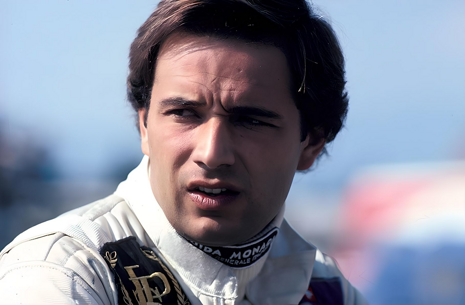


In California they don’t seem to worry too much about the energy crisis that is troubling the world. The increase in the oil price decided by the OPEC producers, the closure of many nuclear power plants and the ensuing controversy (after the leakage of radioactive gas at the Harrisburg plant in Pennsylvania) in the United States itself, appear to be far-off events, unable to touch the well-being and tranquility of those in a region rich in resources, dominated by the desire to live to the fullest and have fun. Here the pumps for the oil extraction - scattered almost everywhere - extract the black gold with a haunting rhythm, day and night.
The incredible sixteen-lane highways on two carriageways continue to be crossed round the clock by endless rows of huge cars; the locals, restaurants, hotels are full of people coming and going. No wonder, then, that the organizers of the US West Grand Prix, the fourth round of the Formula 1 World Championship, have officially announced that they have already paid to Foca, the association of manufacturers headed by Bernie Ecclestone, the large sum of 875.000 dollars as a contribution to the expenses to be incurred. Of this amount, $600,000 will be distributed as prize money, while $275,000 will be allocated to cover transport and travel expenses for the association’s member teams. A record—never before had such a figure been paid for a single Grand Prix—which highlights the level of importance this race has now reached.
The organizers have committed to such a high level of expenses because they are confident the event will still yield a healthy profit, even after allocating a further $165,000 for the preparation of the city circuit. They have also secured a substantial number of wealthy sponsors and are counting on around 100,000 paying spectators. Considering that some tickets are priced as high as $100, it is easy to see how the event could ultimately generate a surplus.
The organizational merits (everything has been improved and it seems that even the timing, which last year was a source of many problems, is perfect indeed) are to be added to those on track safety work, which has always been considered very dangerous. Protective nets, stacks of old tyres, a wall of concrete blocks that practically surrounds the entire track have been flanked by a faster service for assistance along the route, with the possibility of intervening from new exits and entrances. Everything, in short, seems to have been carefully prepared for the fourth act of the World Championship.
The fourth round once again sees Ligier and Ferrari as the leading contenders, as the new Lotus 80—tested in recent weeks in Spain—has revealed several issues and will only make its race debut in Madrid in about a month. Ligier, which has undergone a series of minor evolutionary updates following testing in Spain, continues to be the car to beat, despite the setback in South Africa. The team’s sporting director, Gérard Ducarouge, dismissed the Kyalami race as unrepresentative and remains confident that Jacques Laffite and Patrick Depailler will return to winning ways and strengthen their lead in the World Championship.
Equally compelling are the reasons Ferrari can be considered among the race favorites: the success of the new T4 in South Africa, a strong track record at Long Beach, and the use of Michelin radial tyres on city circuits—all factors that cannot be overlooked. Scuderia Ferrari has brought three T4s to the United States, including one completely new car that still requires testing. Unfortunately, due to an internal transport strike in New York, the cars were briefly held up at a northern airport. However, the issue is expected to be resolved within a few hours, allowing the mechanics to begin their work promptly.
Mauro Forghieri details the modifications made to the cars:
"Compared to the ones that debuted at Kyalami, the cars now have about seventy small and large modifications. It starts from the change of the body that had cracked in the attachment points of the small chassis that supports the front suspension, the adoption of a larger version of the braking system up to additional air intakes for cooling the rear discs. But the most important news will be aerodynamics. We will try an advanced spoiler, mounted immediately ahead of the axis of the rear wheels, which will have the advantage of a larger size to obtain a great grip in the curve".

In the weeks leading up to the US West Grand Prix, on Tuesday, March 13th, 1979, the Executive Committee of the Italian Automobile Club confirmed that the Italian Grand Prix would be held in Monza. The following day, Bernie Ecclestone announced the possibility that, since 1980, cameras could be mounted on Formula 1 cars, in order to allow the viewer to watch the race from the driver’s perspective. However, this is not the only expected change: in fact, the great increase in the performance of the cars, due to the introduction of the ground effect, pushed FOCA and FISA to try to change the technical regulation, for future seasons. For 1980 it is proposed to increase the minimum weight of single-seaters, as well as to limit to 1,000 cc the maximum displacement for turbocharged engines; the abolition of miniskirts is to be proposed for the year 1982.
On Wednesday, March 14th, 1979, the new Lotus 80 was introduced at the Brands Hatch Circuit. However, the car would not be used in the United States West Grand Prix, where Copersucar-Fittipaldi would continue with the F5, while Team Wolf would debut the WR8 for the first time. Initially, a debut for the new Renault F1 car was also planned, but this did not occur. During the Grand Prix weekend, Williams unveiled its new single-seater, the FW07, which would make its race debut at the Spanish Grand Prix.
There was also talk of the possible debut of the new ground-effect Renault turbo, but the debut was postponed to Spain. Still waiting for the start of the race weekend, Niki Lauda becomes father for the first time. His wife, Marlene Lauda, gave birth on Tuesday, April 4th, 1979, in the morning – it’s a beautiful boy, who enjoys excellent health. The Austrian gets the news of the birth of his firstborn son as soon as he arrives in California, where he is to participate in the US West Grand Prix.
"I’m happy but I still don’t know what his name will be. I haven’t had time to think about it yet. We’ll see when I get home".
The former World Champion, apart from the happy news, is very interested in aviation, his favorite hobby and future job when he decides to leave this competitive sport. He is seen visiting the Douglas workshops, asking for the price of a DC 10.
"They want $45.000.000, 15 months waiting. That’s incredible".
As time goes by, the wait gets feverish. While riders enjoy the last hours of relaxation, playing tennis and football along the beaches, mechanics work day and night to fine-tune the cars. This Grand Prix engages teams and technicians in a careful work of finishing up the mechanical parts of the single-seaters - street circuit ahead, slow and tortuous, aerodynamics will be less decisive. Together with the free practice preparations that will start on Friday at 10:00 a.m. with a one-hour session, the show will continue at 12:30 a.m. with the first qualifying round; the usual American side initiatives flourish.
The election of the Miss Grand Prix, the parade of competition cars, a parade of majorettes and folk groups are the corollary of the automobile event. Also this year the mayor and the organizers of the race have decided to help those citizens who live in the houses located in the immediate vicinity of the track. Those who can’t stand the noise and confusion can spend three days of vacation in nearby Las Vegas, with all the expenses (less obviously those related to gambling) being paid for.
Some also take the opportunity for publicity, such as the organizers of a coast-to-coast race—from Florida to California—featuring 43 cars, two motorcycles, and an ambulance. The event was won by a Jaguar XJS, which completed the 3,000-mile course in 32 hours and 58 minutes, averaging about 90 miles per hour—slightly less than the 88.5 miles per hour with which Carlos Reutemann won the US West Grand Prix the previous year with Ferrari. However, these results hold little interest for the Formula 1 “circus,” which, as mentioned, is fully focused on the final preparations for the Grand Prix.
Ferrari mechanics, for example, do not even have a free moment for distractions as the three T4 blocked at New York airport on arrival arrive in Long Beach only Wednesday night, forcing them to a real tour de force for final preparation. Greater attention is on the Italian cars. Last year’s victory, as well as the double in South Africa, make the Maranello cars the main favorites for the race. The only question that remains is which of the two drivers—Jody Scheckter or Gilles Villeneuve—to target. The South African has no doubts:
"I want to conquer the world title and then I will try not to miss the opportunity. In Kyalami I missed the victory because I was also unlucky".
Gilles Villeneuve appears much more moderate. Despite the birth of a little boy, the Canadian - who is always followed by his wife Joanne and the two little children - is now a temperate and mature man.
"At this point I know what my chances are. I know I can also win and this race adapts to my driving characteristics. The tight 90-degree corners, the type of track, make it a kind of circuit I’ve always raced on. But I do not have too many illusions because I know that it will be very hard".

Some say that there will be a great rivalry between Villeneuve and Scheckter.
"For the moment there are no problems. We have equal cars, equal engines. We fight on equal terms. Only later in the season, when the situation in the standings will be clearer, we will see who can aim high. I now know that Jody is the lead driver, and that if, due to an unfortunate circumstance, both cars were to break down, I would be left on foot, forced to watch the race. But that doesn’t bother me".
Who will be the main favorites for the race?
"Together with Ferrari I would put, it is clear, the two Ligiers of Laffite and Depailler and also the Brabham-Alfa of Niki Lauda. I am convinced that the Austrian will have a good race because he has a great desire to win and a car that is competitive on this circuit. I also see the Tyrrells. As for the Lotus, however, I would not put them among the probable winners. Otherwise I would have to make other mentions".
In the shadows there are also the Italian drivers who will be in the race, Elio De Angelis on his Shadow and Riccardo Patrese with the Arrows. The Paduan, in particular, has proud intentions of revenge.
"He will soon be able to win a Grand Prix. The Arrows design engineer has prepared a new car that will most likely debut in Belgium. An extraordinary car that I have already been able to admire in the projects, which has really innovative solutions. A car that will allow me - I repeat - to finally win a race".
Patrese doesn’t think he’s exaggerating by saying these things. He is convinced that Southgate, the team’s designer, is a real phenomenon and that in terms of aerodynamics and chassis is second to none.
“When others see my car, they will be surprised. Not even the new Lotus 80 or Brabham BT48 feature such original solutions—especially at the rear, where my engineer has designed a spoiler unmatched in Formula 1. The car will reach a top speed approximately twelve percent higher than the other current machines, and I’ve confirmed that it will corner much faster than the Lotus 80. With this car, I intend to win my first Grand Prix”.
But this version of the single-seater for the moment only exists on paper. Is Patrese really convinced that what you saw is truly that impressive?
“Of course. The data from the wind tunnel is more than reassuring. We are confident that the new Arrows will have no rivals. That’s why I remain calm, even if I have to race a car that is somewhat old and uncompetitive. So far, I haven’t been mentioned much because I was considered too old-fashioned and difficult to drive. Rest assured, when the race comes to Belgium, you will hear the name Patrese again. I’m not saying this for free publicity, but because I am absolutely certain of what I assert”.
As for the Long Beach race, what do you think?
“I have particular faith in Scuderia Ferrari. Scheckter and Villeneuve, in their Maranello cars equipped with Michelin tyres, will have no rivals on this street circuit. I believe Ligier might cause some trouble for the two Italian cars, but nothing more. As for the others, they are too far behind these two machines. The T4 is an extremely competitive car that I expect will handle the tight corners of Long Beach perfectly and has the acceleration needed to secure victory with confidence. The main challenges for the Italian car will come in Europe, when the Lotus 80 finally debuts, and especially when my Arrows is on track. I may sound presumptuous saying this, but I assure you it is not so. The proof will come…”.
Bets are divided into two. Thousands of dollars on the Ferrari, a little less on the Ligier. These are the two favorite cars for the Grand Prix which will constitute the fourth act of the World Championship. But in the Formula 1 environment there are many chances also for Niki Lauda’s Brabham-Alfa. Why is the Austrian again in the limelight? Many argue that the car is particularly suited to the type of street circuit, slow and tortuous. The Alfa engine, bright and elastic, would give Niki those advantages that do not offer aerodynamics on the fastest tracks. Moreover, for too long, the former World Champion no longer has the satisfaction of a victory.
"It’s time to regain lost time. I don’t know if I’ll be able to fight for the world title, but I want to at least get back to winning once. My last success was at the Monza race last year. But I don’t even want to remember it. It was a tragic day. The antecedent was in Sweden, when we adopted the famous fan. No clear success, therefore, for a long time for me. I hope this is the right time".
Lauda is convinced he can make a good run. He doesn’t say who his biggest opponents will be, but the question is implied. The only one who does not believe much in the Austrian is the engineer Carlo Chiti, in charge of Autodelta, the sports section of Alfa Romeo that supplies the engines to Brabham.
"Niki doesn’t seem the same as he used to be. He seems less focused and even in the tuning of the car is not as precise as he used to be. I hope that this is a temporary crisis because of the lack of results. And I hope that a possible success on the Long Beach track will bring Niki back to the top of the rankings among the best drivers".

For the race scheduled for Sunday, starting at 12:55 a.m., a record crowd is expected: there is talk of over 100.000 spectators coming from all over the United States and also from abroad. The hotels in Long Beach are fully packed and the wait seems to be growing feverish. All teams have defined the tuning of the cars and the first official practice will start on Friday. Even Ferrari solves, in the meantime, all its problems. On Wednesday evening the cars arrive in Long Beach, while on Thursday the equipment and spare parts arrive. The mechanics underwent an authentic tour de force, but in the end they managed to fine-tune the cars for both Scheckter and Villeneuve. So the battle is open. Ferrari, Ligier, Brabham: who will win?
Formula 1 changes the scenery. From the South American heat to the Kyalami high. Now to the city streets of California. And, once again, the different placement of the race causes upheavals in the subtle game of balancing forces on the field. In qualifying Lotus suddenly reappeared to act as an intermediary in the speech that seemed limited to Ligier and Ferrari. The most surprising fact is that it wasn’t the new car from Colin Chapman, but the now 39-year-old Carlos Reutemann who also made a return at Long Beach, on a circuit that has always suited him well.
The Argentine gets the best time in the first day of practice, characterized by extreme uncertainty, with many drivers very close to each other in the best positions of the ranking. This result gives a more human dimension to the world of the Great Prizes and also places the emphasis on a certain validity of the circuits built in the city, in the streets normally crossed by everyday traffic. Here the sophistication, the ground effect, the miniskirts, the tyres, assume a less decisive importance. The driver, with his courage, with his skill, with his technique returns to be the protagonist. But as Carlos Reutemann says:
"These are just the tests, but the race will be something else".
A sentence that can mean that on Sunday the thirty-six-year-old South American will try to enforce his sudden return to the top, or perhaps that he thinks he can not repeat in the race the exploit of qualifying. However, the fact remains that Lotus is again in the running as Andretti is also able to fight to win. Much depends on Ferrari and Michelin tyres that on Friday, in truth, disappoint expectations, as it was thought that they would have a considerable margin of advantage over those Goodyear.
During the first races, however, the Maranello team does not have the opportunity to work thoroughly due to two accidents that occurred since the first laps in Villeneuve and Scheckter. The Canadian collided with a guard, in the morning, a minute after the start of the free practice. His car, the same one he won in South Africa, got caught, because of an uncontrolled skidding, in a bunch of used tyres, located at the exit of a corner, as a safety barrier. The blow is so violent that the right front suspension of the 312 T4 bends and for Villeneuve the tests end here. Shortly after, on the seventh lap, it was Scheckter’s turn. In braking, Jody hit Pironi’s Tyrrell.
“It was my fault: I was going at least 50 km/h faster than the Frenchman and expected him to brake later, as I had planned. Instead, he slowed down suddenly, and I couldn’t avoid the collision. A real shame, because I ended up ruining the new car”.
In fact, this 312 T4, which Scheckter should have used in the race, with all the changes, including aerodynamics, made after the last tests in Fiorano, appears in poor condition and can only be used as a reserve car. The impact is violent, so much so that the left front wheel gets stuck, crushing into the body, ruining both the side and the upper dome, something that had never happened before, even in more spectacular accidents. These two episodes force the mechanics of Ferrari to work extra to repair the cars, but, obviously, the time available for a new tuning and to look for the best solutions is very limited. Scheckter and Villeneuve will probably have to race with the T4 of Kyalami.

The Formula 1 World Championship looks set to an exciting season. The fight between the different teams for technical supremacy and that between the drivers for the title is very uncertain and very tense. It takes a little to change seemingly unassailable situations. Two examples can give a fairly real picture of what is happening: the defeat of Ligier in South Africa, when it seemed that the French car could not have rivals, and the return of Lotus to the top when no one believed in the old cars of Colin Chapman. Obviously, these facts have an explanation.
The success of the new Ferrari 312 T4 at Kyalami was determined by several components. The competitiveness of the car, its best performance at high altitude of the circuit, the skill of the drivers, the validity of Michelin tyres. As for the reappearance in the very first positions of Ruehlemann and Andretti with the Lotus 79 (and with them other drivers like Patrese and Ragazzoni) the reasons are simple. And in this regard we must reveal a background regarding the qualifying tests.
Despite a quiet performance in the opening qualifying sessions, Ligier seems to have fully recovered from the psychological setback of the South African defeat. The French team is confident that the United States West Grand Prix will offer the chance for their third victory of the season. Jacques Laffite, who due to a tendinitis in the right arm, has to undergo a series of intensive treatments and runs with a showy rigid bandage, continues to say that there are no problems and that in the end the Ligiers will come to the fore again. The Parisian driver also finds time to joke, playing down the rivalry that divides him with his teammate Depailler:
"First I had to be a driver and a test driver. Now. Instead, I can rest by limiting myself to the effort of the races, as Patrick takes care of the tests".
Not everything, however, runs as you would like to believe, in the transalpine team. The cars report some problems. Incredibly, the fact of being so fast brought inconvenience to the brakes. In essence, the system is no longer suitable for the needs of a car that at every turn arrives very quickly and must slow down in a few meters. Says the Ligier sports director, Gerard Ducarouge:
"This is currently our biggest drawback. We have already tried new carbon fiber brakes, aeronautically derived, but we have not yet been able to use them. We can probably mount them on the cars for the Jarama race. And from that moment we will be able to use one hundred percent of the resources of our car".
The brake problem justifies the not brilliant behavior of Laffite and especially of Depailler in the first day of tests. Depailler in particular, at a certain point, he no longer knows how to behave and tries to correct the braking by himself with the adjustment system located in the passenger compartment, which allows to increase or decrease the braking effect on each of the four wheels, one independently of the other.
The move, however, does not seem to give good results, as Depailler inadvertently unbalances the car, which slips fearfully in every turn of the circuit, where it should slow down. At the end of the tests, Ducarouge will pronounce very harsh words for his driver, asking him to advise the technicians before acting on the adjustment of the car. Laffite also has problems, but with the gearbox that breaks and does not allow him a regular training.
The leader of the world ranking, however, has the intention to get a very cotnpetitive car prepared for the race. After finding that the forklift had a more valid engine than the racing car, the Frenchman asked that an exchange be made between the two Ligiers, taking from each the most efficient parts. That means his intentions are belligerent. However, Saturday, April 7th, 1979, overturns the qualifying result, as Gilles Villeneuve marks the best time.

The pole position obtained by the young Canadian is the result of his maturity; after just two years of Formula 1, the Ferrari driver shows that he has learned well all the lessons he has been given. Since Gilles' exploit deprives Reutemann of the chance to start with the best finish, it can be said that the student beats the master, who had had last year at Ferrari. The secret of Villeneuve is not exceptional but it is enough to show how the little boy from Montreal has understood perfectly how to exploit every possibility that is presented to him on Saturday, after trying all the aerodynamic and set-up solutions that he has available.
Gilles asks just in the last rounds to have the possibility to remove the engine’s rev limiter at the end of the straight, raising the engine up to 12.600 rpm, giving it enough thrust to improve Reutemann’s time by 6 cents. A few moments after qualifying ended, however, it was worth the risk. Also because Villeneuve had noticed that in some corners the second gear was too short and he would have needed to push something more to get the fastest Tomaini, technical manager of the team, gave his approval. The Canadian’s car is back on track and after two laps Villeneuve overtakes rivals with a brilliant timed lap in 1'18"32, marking the new track record.
"I realized that this was the only chance I had of improving my performance and I risked it. It went well because in the next lap, maybe because of the excessive vibrations due to the speed, or because of a jump, the transmission shaft broke and I had to go back to the pits pushing the car. I can really say that I was lucky".
The fate of Carlos Reutemann is different. The Argentine had also tried to set the lap time again but twenty minutes from the qualifying line was stopped by the break of a semi-axle of his Lotus.
"At first I thought I had run out of gas because, to be as light as possible, I had very little in the tanks. Then I realized that it was a problem at the broadcast and so I was forced to arrest myself. Too bad, because I still had almost half an hour left and I could certainly have improved. This is a circuit that allows you to remove fractions of a second on every lap when you know it well".
Gilles Villeneuve proved to be the sharper driver, securing pole position for the upcoming USA West Grand Prix. Meanwhile, Colin Chapman, together with Carlos Reutemann and Mario Andretti, is eager to advance the development of the new Lotus 80 as quickly as possible. The car was originally slated to debut at the Belgian Grand Prix in Zolder, but to speed up progress, Andretti is expected to begin testing the following week, likely on Thursday at the same track. Should the test sessions yield positive results, it is possible that the Italian-American driver will also take part in the Race of Champions at Brands Hatch, an event that does not count toward the Formula 1 World Championship.
During Sunday morning’s warm-up, Jean-Pierre Jabouille suffered a catastrophic failure when a joint on his Renault broke in the long Shoreline Drive curve, sending him crashing into the barriers at 290 km/h. A resulting dislocated arm forced him to withdraw from the race. Later, a stronger version of the coupling, manufactured in the team garage, failed on his teammate René Arnoux’s car. To prevent a repeat of Jabouille’s accident, Renault decided to withdraw the second car from the race, allowing two previously unqualified drivers—Derek Daly in the Ensign and Héctor Rebaque in the Lotus—to take their places on the grid. An anticipated crowd of 100,000 will witness the afternoon race, which will begin under the sun. As in the previous year, the start takes place on Shoreline Drive, providing extra space for the drivers to spread out before reaching the first corner.
With that the field was sent to form up on the grid from the pits, although only 23 of the 24 starters would make it to the their grid slots. The lone casualty would be Carlos Reutemann, whose Lotus had suffered an electrical failure and needed to be towed back to the pits. The Norfolk squad quickly diagnosed the problem and cured it, but the Argentine was forced to start from the pitlane as per-FIA rules regarding the closing of the pitlane prior to the start. That left Gilles Villeneuve on his own on the front row, with the Canadian duly leading the field away on the formation lap without issue. As they passed the pits midway around the tour, however, Reutemann burst out of the pits and slotted in behind Daly, hoping that no-one would notice. Unfortunately for him Villeneuve would mess up his positioning on the grid, overshooting his grid slot having received no guidance from the marshals.
With no other course of action left available Villeneuve decided to start another formation lap, taking Jody Scheckter, Patrick Depailler and Mario Andretti with him. Jacques Laffite, meanwhile, would try to go with them, only for his gearbox to lock the rear-axle solid and spin him around, blocking the circuit. The top four were left to circulate around on their own, while the rest of the pack slowly trickled past the stranded Ligier, before being stopped at the pits and put back in grid order. Once Villeneuve and co. returned the were sent on their way once again, this time heading from the end of the pit-straight to the start-line. Laffite was not among them having jumped into the spare Ligier, while Reutemann had been dragged back into the pits and told not to try and join the field again risking the disqualification.
After all that the race finally got underway, with Villeneuve streaking into Queen's hairpin barely ahead of teammate Scheckter, who tried an ambitious move on the outside of the corner. Depailler went with them and duly tried to squeeze inside Scheckter as he ran wide, causing the rest of the pack to bunch up as they hit the brakes. Somewhat inevitably this would cause a collision, with Patrick Tambay shooting into the back of Jan Lammers and launching his McLaren into the air, before crashing down on top of Niki Lauda's Brabham.

Both the McLaren and the Brabham were out on the spot, sending cars scattering around to try and find a way past. That resulted in some major changes at the lower end of the pack, and meant that Laffite and Reutemann had a longer wait than expected as the backmarkers took a long time to complete the first half-lap. Fortunately, the scene of the accident was clear by the time the leaders returned to the hairpin, still on the official opening lap, with Tambay and Lauda already walking back to the pits.
Come the end of the opening tour and Villeneuve had already built a small lead over Depailler, whose move on Scheckter had been overshadowed by the collision behind. The South African ace himself was in third ahead of Andretti, with Jean-Pierre Jarier, Riccardo Patrese, Alan Jones and Nelson Piquet completing the lead group. They were being chased by the next bunch held up by the Tambay accident, miraculously led by Héctor Rebaque from the back of the grid, while James Hunt was already out with yet another driveshaft failure.
The early stages would see Villeneuve, Depailler and Scheckter pull away from the chasing pack, aided by Jarier attacking and passing Andretti on the second tour. Yet, the Frenchman simply lacked the pace of the lead trio, and duly began to slip a few tenths a lap away from them, with Andretti, Patrese, Jones and Piquet glued to his tail. Behind, Rebaque began to slip back down the order as the rest of the field sorted themselves out, while Reutemann was casually carving up the order after his pre-race issues.
Back with the leaders and Jarier began to get into the rhythm of things in his Tyrrell, and duly closed onto the back of Scheckter on lap seven. One lap later and the Tyrrell was scything inside the Ferrari on the brakes for Queens, before shooting away to harass the second placed Tyrrell. Another lap and another dart on the brakes and Jarier was through past his compatriot, leaving Depailler to defend, unsuccessfully, from Scheckter.
Yet, try as he might, Jarier simply could not catch Villeneuve out front, with the French Canadian maintaining a three second lead over the Tyrrell without much issue. Elsewhere, Laffite had already given up in the spare Ligier, which had not been touched at all during practice or qualifying, while Reutemann suddenly found himself a whole lap down while harassing Rebaque. Arturo Merzario was another early casualty with an engine failure, while Emerson Fittipaldi dropped out with yet another Ford Cosworth related driveshaft failure. By lap twenty Jarier's hopes of victory were over, for Villeneuve had begun to push hard and opened out a healthy lead, leaving the Tyrrell to be harassed by Scheckter. Depailler, meanwhile, had dropped into the sights of Andretti, although the American ace was not able to launch an attack on the Frenchman, for Jones was glued to his tail and threatening a lunge.

Piquet would chase them hard until he had to stop for fresh tyres in the sole-surviving Brabham, while Reutemann's race was over a lap later with (as expected) a driveshaft failure. Tyre wear would soon become the order of the day for the leaders, with Jarier having burned through the best of his Goodyear rubber by lap 29, effectively gifting Scheckter second. The Frenchman duly slipped back to Depailler and co. before half distance, although Jochen Mass had more serious trouble, seeming to lack any grip at all on the rear of his Arrows. Indeed, the German driver was barely able to keep his car in a straight line on the straights, and would eventually gift Rebaque a position as he swung perilously close to a concrete wall.
Back into the fight for third and Jarier's troubles were allowing Andretti to attack, the American ace slipping ahead of Depailler just before half-distance, before an aborted attack on the Tyrrell. That allowed Depailler to retake fourth, before Jones sent his Williams skating past Andretti's Lotus on the brakes at the hairpin on lap 39. Indeed, it was a beautifully timed move by Jones, for not only did it put him ahead of Andretti, but it was completed right in front of the team's sponsors as they were being entertained at the Queens hairpin.
Jarier, meanwhile, would be forced to abandon third place on lap 46 with a trip to the pits, the vibration from one of his tyres becoming too much for him to cope with. Depailler duly inherited third, although that position was up for debate as Jones and Andretti remained glued to his tail. Jarier's disappearance also promoted Rebaque into the points, the Mexican ace having picked up more places as Patrese, Pironi and Clay Regazzoni all hit mechanical trouble mid-race.
Into the closing stages and the fight for third was the only real source of entertainment, although there seemed scant hope of Jones actually making a move stick on Depailler. However, an opportunity finally arose when the trio came up to lap a group of back markers on lap 61, a huddle which included Jarier's freshly shod Tyrrell. In the sudden flurry of overtaking that followed Jones slipped the Williams ahead of the Ligier to grab third, while Andretti got caught behind a reinvigorated Jarier and slipped back. With that the race seemed to be over, although three late issues would shuffle the order in the points with a handful of laps to go. The first saw Depailler's Ligier suddenly lose fourth gear, a breakage that mutually allowed Jones to disappeared up the road and Andretti, now with Jarier glued to his tail, to close up and ultimately snatch fourth place from him.
The other incident saw Rebaque trip over fellow back-row starter Daly while attempting to lap the Ensign, sending the Mexican's privately owned Lotus skating into the barriers. The final points were hence set to be handed to Jarier, although with Depailler's pace suddenly nose-diving after the loss of fourth gear it seemed as if another position was up for grabs. As such, Pironi and Elio de Angelis began fighting hard on very worn tyres, resulting in some seemingly harmless contact, only for Pironi's suspension to suddenly collapse and send him skating down an escape road. He was subsequently pushed back onto the circuit and disqualified, although the Frenchman only managed to limp back to the pits with his ruined suspension.
Out front, meanwhile, Villeneueve truly was in a class of his own, collecting fastest lap with a new lap record en-route to a dominant victory, thirty seconds clear of teammate Scheckter. Third went to Jones after his combative performance in the Williams, while Andretti was a relatively lonely fourth after letting Jarier escape up the road. Depailler ended the race in fifth, his gearbox just surviving to the checkered flag, while Jarier himself claimed sixth having lost a lap due to his stop.

Another double from Ferrari, another victory for Gilles Villeneuve. The Canadian driver achieved his third success in the Formula 1 World Championship, the second consecutive, at the end of a race conducted in an exemplary manner, always in the lead, without a single mistake. In second place, Jody Scheckter with the other Ferrari. The Italian team responded to the amazing results that Ligier had achieved in the first two races of the season, in Argentina and Brazil. Then the French car got a first and a fourth place in Buenos Aires, and a first and a second in Interlagos.
Ferrari does even better: first and second in Kyalami, same result in California. However, it is a fairly complicated race, especially at the start. But once the Grand Prix kicks off regularly, Villeneuve has no more problems even in the numerous overtakings, in which he performs with extreme confidence. Only five cars finish full laps, after 80 laps on the short circuit of Long Beach: besides, of course, in Villeneuve and Scheckter the talented Alan Jones, who always emerges on this kind of tracks, Mario Andretti, combative as ever, and Patrick Depailler. All others are irretrievably detached or eliminated by numerous inconveniences.
As we said, the race has a tricky start, difficult because of a not perfect start. Sunday, April 8th, 1979, the cars start from the short straight of the pits to line up on the other side of the circuit, on the only long straight of the track. After completing the reconnaissance lap, at the start, which is almost launched, Villeneuve sees Depailler side by side and makes a sign to continue. The Canadian interprets the French sign as an invitation to go ahead for another round of reconnaissance and then takes off. Almost everyone follows in the wake of the Canadian driver, but the traffic light is not green. For this reason the start must be repeated.
About half an hour after the start the head of the race commissioners, John Barnholdt, warns the managers of Ferrari that there is a possibility of a penalty for Villeneuve; in essence, race director Burdett Martin notifies the Maranello team that he has reported to the sports stewards of the alleged infringement of Villeneuve (and also Reutemann) for early departure. In essence, an additional survey is requested. This takes place around 1:30 p.m., half an hour after departure. The notification, however, is exorbitant after 2:00 p.m., when there is no longer any chance to intervene.
With this possible penalty, Villeneuve leads in the lead until about half the race, when Chris Puch, chairman of the organizing committee, says that there would be no penalty and that at most a fine would be imposed on the Canadian, as it will happen. Just in the first lap of reconnaissance Reutemann had accused trouble to the electrical system of his Lotus and Laffite, who faced the race crippled by a right wrist tendinitis, transmission problems to Ligier. The two drivers had stopped in the pits and for this reason, at the second start, they were forced to start at the tail of the group, starting directly from the pits after the passage of all the other cars in the first lap. Laffite starts with the forklift because his racing car is broken, but his race lasts very little, as the ninth step stops permanently for boredom at the brakes.
Even Reutemann (who will be fined as Villeneuve 10.000 Swiss francs for not having complied with the orders of the race commissioner starting from the pits before the deadline) will not go very far. At the twelfth lap he is forced to stop with the front tyres completely damaged, and his race ends later while he is trying a comeback, exactly on the twenty-first lap, for the breakage of a semi-axle. On the first pass of the second start Niki Lauda bumped into Tambay. In fact, the Austrian was inside the hairpin that ends the longest straight and had the Frenchman on the outside.
Making the turn. Niki has an enlarged leg, he leaned with his Brabham on McLaren and the two cars collided. Tambay turned half on the track and immediately stopped on one side, while Lauda was able to proceed for a few meters and then stopped in turn. Stopped in the pits almost immediately, on the third lap, also James Hunt, who announced himself as one of the protagonists: for his Wolf a mechanical failure.
Meanwhile Villeneuve continues to lead with extreme determination, without ever giving up the pace, and progressively detaches all rivals. Scheckter gets upset with Depailler, and drops from the third position to the fourth, but then gradually gets closer and overtakes Jarier on lap twenty-six, who is in second position excellently placed, putting himself behind the team-mate. With the two Ferraris in the lead from lap twenty-six, the fight is limited to the recoil positions. Patrese, who had a great start and is in sixth position, is forced to retire after the fortieth lap for boredom on the brakes. Little by little Jones emerges, who first overtakes Andretti and then Depailler, and then moves on to fourth position in favor of Andretti.

After the race, Gilles Villeneuve celebrates his third victory in Formula 1 traveling by plane. The Canadian, in fact, due to an urgent commitment in Montreal, is forced to leave California immediately after his success in the United States West Grand Prix. A clear success, without arguments, even if troubled by a nervous and confused race from the beginning. The statement of the small Canadian driver, as mentioned, is completed by the second place of Jody Scheckter. A real triumph for Ferrari that leads, with Villeneuve, in the World Drivers' Championship and, with its own cars, in that of manufacturers. Villeneuve, at the end of the race, before leaving, releases some polemical jokes against the organizers. The fact that he was fined 10.000 Swiss francs for not stopping at the start after the reconnaissance tour literally made him furious:
"I’d be willing to pay that after every race if I won them all. But it’s very unfair to me. I didn’t commit any infractions. When I left, the commissioners did not tell me to stop and I thought I still had to make a lap before the authentic start. I was also deceived by Depailler who signaled me to continue. However, there was no departure, and only the second one was valid. I don’t understand why they wanted to hit me at all costs. Maybe to show that they are strict. But I don’t think they would have penalized me by a minute".
In fact, during the race, there was a rumor that the Canadian would take sixty seconds of penalty for this somewhat rash gesture. Then, instead, everything returned to normal and in the end Villeneuve only suffers the fine that he will have to pay personally. Nevertheless, it is useless to say of the irrepressible joy of the little Canadian driver, who however continues to retain all his modesty and his seriousness. Villeneuve has made many friends in a short time. Ferrari mechanics consider him a great guy, many other drivers admire him.
"It wasn’t a tough win. I only got the most in the first six laps. When I realized that I had already detached everyone, I just kept a certain rhythm. There was a lot of confusion at the start. The signals for the exact deployment were missing. Also, I shouldn’t have had anyone on the side, as Reutemann started from the pits. I was tricked by Depailler instead. I saw the Frenchman flanking me and signaling to move on. So I left. From that moment I had no more problems. Only a little understeer at the end, but the car went, on the whole, very well. I am very satisfied".
On his position as world championship leader, Villeneuve has very clear ideas.
"It’s very nice to be at the top of the leaderboard, but it’s too early to make any ambitious plans. For now I’m going to keep on living the day. I’m a bit afraid for the Spanish Grand Prix. Last year at the Jarama track we had trouble with the tyres. I hope that the situation has changed and that the progress we have recorded also applies to the Spanish circuit".
Jody Scheckter seems quite pleased with the second place, but on his face there is not too convincing a smile.
"Gilles was phenomenal: once again he won thanks to a careful choice of tyres. He trusted a softer guy who allowed him to be faster. I thought he had to stop at the pits to change tyres and I was convinced that I had the victory at hand. That’s why I chose a harder and stronger compound. Instead, he was right. My race was pretty smooth. I bumped into someone when I left, but I don’t know who he was. The bump bent the front wing of my car, but this inconvenience did not give me any problems".
Scheckter says he doesn't know who hit him, but there are many who say that the South African, in the heat of the start, moving from one side to the other of the track, would have even touched Villeneuve. Neither driver, however, confirms these rumors. Of course, looking at the line-up, with the Canadian in the front row and Jody behind him, one wonders what other driver might be the one hit by Schekter. In any case, fortunately, the accident did not cause irreparable damage. The victim of a bad collision was instead Niki Lauda, eliminated after 300 meters of competition. The Austrian left Long Beach for Salzburg nervous.
According to television footage, it appears that there was at least one guilt match between Lauda and Tambay. In fact, it seems to see the Brabham-Alfa turn in the hairpin bend inside and then widen and push the McLaren outwards, making it rotate on itself. However, the images, unclear, would have done a wrong to Lauda. It is the same Tambay to take the blame for what happened.
"I miscalculated the trajectory and hit Niki’s Brabham. I’m very sorry".
Lauda’s explanation is sarcastic.
"I suddenly saw a car flying under mine and only when I could observe it well, I realized that it was the McLaren of Tambay".
Its version seems supported by the fact that the Brabham is presented with the rear wing completely torn and with the exhaust pipes bent at the top. The fourth place seems to satisfy Mario Andretti, who however does not spare the accusations to his countrymen.
"The American sports stewards behaved like real amateurs. They made us line up like sheep. Amazing thing. I could not make a great race, because of problems with the electrical system I could not take all the laps to the engine. At the beginning, when my Lotus was still good, I was about to put in Jarier and Depailler, but I found myself in front of Daly who was already voiced and I had to give up. Then I tried only to finish, bringing home those few points that I could grab with the fourth place".

Even Reutemann, protagonist of a very unlucky race, suffers the same fate for not respecting the order to stay in the pits until the end of the passage of all the competitors after the first lap. The Argentine had stopped during the reconnaissance and had returned to the stands to repair the electrical system. According to the rules he had to stop, but Carlos, in the heat of making a good race, did not, had waited for the report of the commissioners of the route. Apart from these two episodes, the race was dominated in full by Ferrari who had no problems, thanks also to the radial tyres of Michelin, to line up all opponents. Surprising instead the third place of Alan Jones, with the old Williams. On this street circuit, his was one of the most beautiful battles of the whole race.
A race that has reserved surprises all the time, from the beginning. Dramatic the elimination of Niki Lauda, immediately after the start. The Austrian saw the McLaren of Tambay flying literally on his head, which first flanked him and then climbed over him destroying his car. Now Formula 1 will move to Europe. Apart from these two episodes, the race was dominated in full by Ferrari who had no problems, thanks also to the radial tyres of Michelin, to line up all opponents. Surprising instead the third place of Alan Jones, with the old Williams. On this street circuit, his was one of the most beautiful battles of the whole race. A race that has reserved surprises all the time, from the beginning. Dramatic the elimination of Niki Lauda, immediately after the start.
The Austrian saw the McLaren of Tambay flying literally on his head, which first flanked him and then climbed over him destroying his car. Now Formula 1 will move to Europe. The extra-European adventure of the World Championship ended in this way: after four races Gilles Villeneuve is in charge of the classic drivers, while Ferrari is in first place in that of the constructors. A result that before the debut of T4 in Kyalami no one dared to hope for, especially after what Ligier had shown in South America. Drivers, technicians, mechanics and - why not? - also the stimuli that Enzo Ferrari continues to give, a man who never lacks the desire to win.
Ferrari triumphs by repeating the double obtained in South Africa, but the fight is always open. It was confirmed that T4 is a competitive car, that Michelin tyres are in further progress, that the car-tyre combination is winning especially on slow and winding tracks. But the next race, April 29th, 1979, in Spain, at the Jarama. will kick off new battles because all propose immediate revenge. From now on, there will be no stopping for anyone. Andretti will test the Lotus 80 starting from Thursday, April 12th, 1979, at the Zolder. circuit in Belgium.
If the tests end on a positive note, he will compete on April 15th, 1979, at Brands Hatch. In the same Race of Champions, held to raise funds for the Gunnar Nilsson Foundation for Cancer Research, Brabham will debut a completely redesigned BT48, featuring updated bodywork. Ferrari entered Gilles Villeneuve with the T3A, the latest version of their older model, but in the following days he will be at Jarama for tyre testing. In short, these events mark the early signs of a fierce rivalry that will develop over the season. Sunday’s race underscored the intensity of Formula 1, delivering a tense and accident-filled spectacle—fortunately without serious injuries or consequences for the drivers—highlighting just how competitive and unpredictable the championship has become.
Villeneuve and Reutemann, however, paid the price of this situation, punished with a fine of 10.000 Swiss francs. Also on this occasion, sporting authorities and drivers behaved with little professionalism, then launching accusations against each other. The facts are soon explained. The regulation states that, once the starting line-up has been completed, all competitors must make a reconnaissance lap, then recompose the grid, and wait for the start signal to stop. When, completed the round of reconnaissance, Villeneuve and his team-mates came back to the starting area, but they did not find the usual signals that indicate to each driver the exact point from which he must start row by row.
The Canadian saw the red light, but he also noticed that he had Depailler on his side, while the Frenchman should have stayed behind. So he thought he could do another reconnaissance lap. He was fined, having not stopped to complete the deploymentA different situation unfolded for Reutemann. The Argentine driver was forced to stop on track due to an electrical issue during the first false start. According to the regulations, he was required to start from the pits after all the other competitors had passed on the opening lap. However, he anticipated his rejoin and, quite rightly, was penalized. Aside from this somewhat confusing and controversial episode, the United States West Grand Prix proceeded in a straightforward and orderly manner.

After the extra-European round, Formula 1 can draw the first balance of the season. After four races, the championship has reached its first quarter, as the season consists of sixteen rounds divided into two groups of eight. Under the current regulations, drivers are allowed to count only their best four results from each of these two phases. Gilles Villeneuve and Jacques Laffite, with two wins each, are on it; but it is still too early to make predictions - they could be reached in the standings and surpassed by rivals in the title race. While waiting for this fight to develop, it is also interesting to check the situation the main teams are in, little by little, we are discovering what they’re capable of doing. With the construction of the T4, Ferrari did not take any rash steps, instead opting for a conservative approach. When engineer Mauro Forghieri sent the new car to Kyalami, he was already confident that it would deliver strong results.
The improved adaptation of the new car to Michelin radial tyres, along with their steady development based on experience gained so far, confirms that the chosen direction is the right one. The only remaining uncertainty concerns the faster circuits, which the T4s of Gilles Villeneuve and Jody Scheckter have yet to tackle. In any case, Scuderia Ferrari is prepared for further evolution of the car. The technicians in Maranello are constantly working to find new solutions. At Long Beach, for example, the T4 introduced an automatic timing system for the first time, based on a radio setup with a small antenna mounted in the nose.
By applying very thin aluminum strips on the track’s asphalt at each pass there is the possibility to control the time with absolute precision. The aerodynamics has also undergone continuous variations. This is proved by the increased spoilers, advanced with respect to the rear wheel axle. The idea did not give particular advantages on this slow circuit, but could offer positive results on other types of track. Ligier, however, after a resounding debut, has fallen in performance, but the problems are about to be solved. The new carbon brakes have given trouble in recent days, the same goes for a small change made to the lubrication circuit of the gearbox.
On April 29th, 1979, Laffite and Depailler, during the Spanish Grand Prix, will be able to return to the spotlight. As for Lotus, the hope of victory depends on the new 80 model. Colin Chapman stated that the Lotus 79 went through almost six months of testing before the car was fully developed. Now he hopes to be faster. His work, however, will be very difficult. Andretti argues that the 80 has major roadholding problems and that changes will be needed in order to take advantage of the revolutionary solutions it has adopted. Given that the new 60 HP Alfa engine offers advantages over the Boxer version, the fact remains that the new Brabham BT 48 suffers from a very difficult set-up in terms of aerodynamics and chassis.
During the Race of the Champions, scheduled on April 15th, 1979, Ecclestone will present a totally renewed body with the hope of being able to solve Niki Lauda’s problems. A Lauda that appears increasingly discouraged and that perhaps begins to regret having made certain decisions. Among the manufacturers who have taken the path indicated by Chapman being the ground-effect cars, probably the team of Ken Tyrrell is the one that has been able to copy the project the best. With two drivers having different temperament, the regular Pironi and the impetuous Jarier, Tyrrell will be a dangerous outsider in every race. Instead, the McLaren team lives in a delicate situation, whose designers have mistaken all the shares.
The McLaren M28 has some incredible set-up problems; both Tambay and Watson often look like they are unable to succeed because of a car that is not fit to hit the road. It will be very difficult for them to recover within a short time. The prospects of the other teams are on the Arrows of Patrese, on Hunt’s Wolf and on the Williams of Jones and Regazzoni. For the Italian and his teammate Mass, Tony Southgate has prepared a car that - the drivers say - should be exceptional, very competitive. The new Arrows will debut in Zolder, Belgium. Hunt seems to have found a good balance for his Wolf and although he was unlucky in Long Beach, breaking a semi-axle in the early laps, he should rise to the top in the next races. The same prediction applies to Williams who built a new ground-effect car, without too many innovations but still a solid car overall.
Finally, in the days leading up to the Grand Prix a rumor had spread in the Formula 1 circus: Michelin would be ready to withdraw from racing next year if they were to win the World Title with Ferrari. According to these rumors, the French tyre manufacturer wanted to take advantage of a winning image to leave a business that is very expensive and technically demanding. However, the Michelin managers have categorically denied such allegations:
"We started a promising exchange with both Renault and Ferrari; we certainly cannot abandon them halfway. Our commitment to the sport will last a long time".
It seems that, contrary to what had been leaked, Michelin intends to expand its range of action considering itself in conditions of inferiority, with only four single-seaters available, against Goodyear that has domain on all the others remaining. If, next year, they were required to supply their radial tyres to another team, Michelin would do so in the interest of supporting a major company with a strong industrial presence. Alfa Romeo would probably it, given that the team continues its journey in Formula 1.